Outline Drawing Vector Design: A Practical Guide to Versatile, Scalable Graphics
In the realm of digital art and commercial design, few formats offer the same level of flexibility and precision as outline drawing vector design. For designers, entrepreneurs, and hobbyists alike, understanding the nuances of vector-based line art is essential for creating assets that remain crisp regardless of scale. Whether you are looking to produce high-quality merchandise, create professional branding materials, or simply add a unique aesthetic to your personal projects, mastering this style provides a significant advantage in both efficiency and final output quality.
Understanding the Core Concept
At its foundation, an outline drawing vector design relies on mathematical paths rather than pixels. Unlike raster images, which are composed of a fixed grid of colored squares and become blurry when enlarged, vectors use points, lines, curves, and shapes defined by geometric formulas. This means that an outline drawing can be scaled from the size of a business card to the dimensions of a billboard without any loss of clarity or detail.
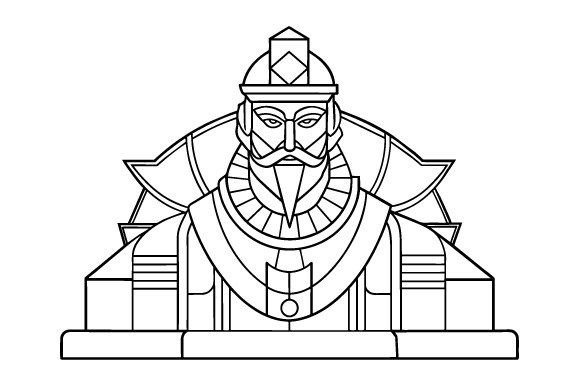
The "outline" aspect specifically refers to the technique where the image is constructed primarily through strokes and boundaries rather than filled areas. This creates a minimalist, clean, and often modern aesthetic. It strips away unnecessary visual noise, focusing instead on form, negative space, and structural integrity. This approach is particularly effective for logos, icons, and illustrative elements that need to be recognizable at a glance.
Key Advantages for Commercial and Personal Use
Choosing vector-based outline designs offers several practical benefits that directly impact workflow and end-product quality. These advantages make it a preferred choice for many professionals in the print-on-demand industry and graphic design sectors.
- Unlimited Resizeability: Because the graphics are built on mathematical equations, they can be resized infinitely. This is crucial for businesses that need the same logo on a tiny favicon and a large banner.
- Easy Customization: Colors can be changed instantly. An outline drawing allows users to swap stroke colors or fill backgrounds with ease, making it simple to adapt a single design for different brand guidelines or seasonal themes.
- Lightweight File Sizes: Compared to high-resolution raster images, vector files are often smaller in data size while maintaining superior quality. This leads to faster loading times for web assets and quicker processing for printing machines.
- Print-Ready Precision: For physical products like t-shirts, mugs, and book covers, sharp edges are non-negotiable. Outline drawings ensure that every curve and angle remains sharp, reducing the risk of pixelation errors during the production phase.
File Formats and Technical Compatibility
One of the most critical aspects of working with vector designs is understanding the file formats available. Different software applications and printing services require specific extensions to function correctly. When exploring resources for outline drawing vector design, you will typically encounter a suite of compatible files.
Primary Vector Formats
The industry standards for editable vector files include .AI (Adobe Illustrator) and .EPS (Encapsulated PostScript). These formats preserve all editing capabilities, allowing designers to modify individual nodes, adjust stroke weights, and rearrange elements. They are ideal for professional workflows where further customization is expected.
.SVG (Scalable Vector Graphics) has become increasingly popular due to its native support in web browsers. If you are incorporating outline drawings into websites or digital interfaces, SVG is often the best choice because it scales perfectly on all screen resolutions and supports CSS styling.
Cutting and Manufacturing Files
For those involved in physical manufacturing, such as using vinyl cutters or laser engravers, .DXF (Drawing Exchange Format) is essential. This format simplifies the complex vector data into pure path information, making it easy for cutting machines to interpret the design accurately.
Raster Previews
While vectors are the source, .PNG files are often provided as preview images or for direct use in contexts where editing is not required. High-resolution PNGs with transparent backgrounds allow for immediate placement onto mockups or social media posts, providing a quick way to visualize the final product without needing specialized software.
Evaluating Fit: When to Choose Outline Vectors
Not every design project requires an outline drawing vector approach. Understanding the tradeoffs helps in making informed decisions about resource allocation and tool selection.
Ideal Use Cases
This style shines in scenarios requiring versatility and minimalism. It is exceptionally well-suited for:
- Apparel Printing: On dark or white t-shirts, outline designs offer high contrast and a trendy, streetwear-inspired look. They are easily customizable to match team colors or brand palettes.
- Branding and Logos: Simple, strong outlines convey professionalism and clarity. They are memorable and reproduce well across various mediums, from stationery to vehicle wraps.
- Decorative Crests and Badges: The intricate nature of vector lines allows for detailed crests and emblems that retain their intricacy even when printed small on badges or large on banners.
- Book Covers and Flyers: For editorial designs, outline illustrations add a sophisticated touch without overwhelming the text. They provide visual interest while maintaining readability.
Limited Applications
Conversely, if a project demands photorealistic imagery, complex gradients, or soft, blended textures, vector outline design may not be the optimal choice. In these cases, raster-based illustration or photography would yield more realistic results. Additionally, for projects requiring rapid prototyping where color fidelity is less important than speed, pre-made raster templates might be more efficient than customizing vector paths.
Comparing Approaches: Vectors vs. Raster Illustrations
When evaluating design options, it is helpful to compare vector outlines against traditional raster illustrations. Raster images, created in software like Photoshop, rely on pixel density. While they excel at capturing nuanced lighting and texture, they suffer from resolution limits. Enlarging a raster image results in visible jagged edges, known as aliasing.
In contrast, outline drawing vector design prioritizes structure over texture. The tradeoff is a lack of organic shading, but the gain is infinite scalability. For mass-produced items like mugs or business cards, where consistency is key, vectors provide a reliable standard that raster images cannot guarantee across different print runs.
Maximizing Value Through Customization
A significant benefit of purchasing or utilizing outline drawing vector designs is the potential for extensive customization. Many online shops offer collections that are updated regularly, providing fresh content for ongoing projects. Because the source files are editable, buyers can tweak elements to better suit their specific needs.
For instance, a designer might take a generic crest vector and alter the internal patterns or change the primary color scheme to align with a client’s brand identity. This flexibility reduces the need to commission entirely new artwork from scratch, saving time and budget. Furthermore, having access to multiple file formats ensures compatibility with various tools, whether you are using Adobe Creative Cloud, CorelDRAW, or free alternatives like Inkscape.
Conclusion
Selecting the right design asset involves balancing aesthetic goals with technical requirements. Outline drawing vector design stands out as a robust solution for projects demanding clarity, scalability, and ease of modification. By leveraging the strengths of vector technology—such as infinite resizeability and format versatility—designers and business owners can create professional-grade materials that resonate with their audience. Whether you are producing custom merchandise, updating your corporate identity, or enhancing marketing collateral, investing in high-quality vector outlines ensures your visuals remain sharp and impactful across all platforms.